Order Filters let you create a set of arbitrary criteria which “filter” the incoming orders and events from your Shopify store, ultimately deciding whether they should be allowed into the app – and whether they should be allowed to trigger your Automation Rules. Every incoming order, order update, order fulfillment event, and order deletion is evaluated against your team’s Order Filters before it reaches the automation system or the Orders dashboard.
For example, if you only want to save orders for products from “Customizable Products” collection, you can create an Order Filter with the Product Collection criteria. Once configured, any order that does not have a product from that collection will be rejected by the Stages app.
As another example, let’s say you’d like to exclude orders from the Stages app unless they have the “B2B” tag. You can do that by setting the Order Tags criterion, and from that point on, Stages will ignore any order that doesn’t have the “B2B” tag – ensuring only those business-to-business orders get imported into the app.
Relationship to Automation Rules
Section titled “Relationship to Automation Rules”Order Filters are not the same thing as Automation Rules. In Stages, an Automation Rule is responsible for sending automated emails or changing stages, and is triggered by you or your team moving an order from one stage to another; an order’s due date approaching or passing; or an order being created or fulfilled.
That last one might sound pretty similar to what Order Filters cover, but the difference is that Order Filters only operate on incoming order events from Shopify, and they don’t take any actions themselves beyond allowing orders into the app.
Allow list logic and the Global Skip Behavior
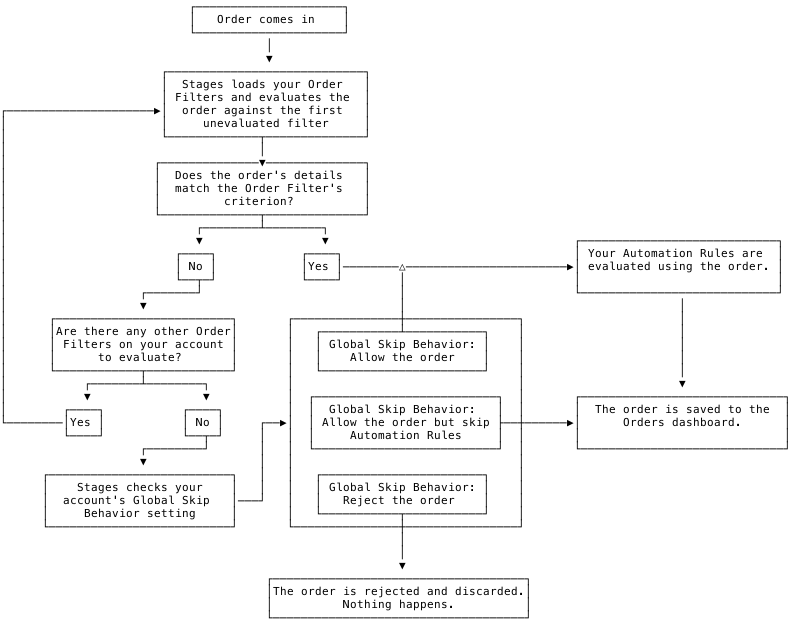
Section titled “Allow list logic and the Global Skip Behavior”Order Filters in Stages use allow list logic, which means each incoming order on your Shopify store is evaluated against the rules and criterion in your filters to see if they’ll allow it into the app to be processed. Think of the filters like a bouncer standing outside the entrance to a popular club, trying to figure out if you put the order’s name on the list of VIPs. If one of your Order Filters evaluates to true, i.e. the order’s properties match the conditions you’ve set on the filter, the order is allowed into the app, saved to your dashboard, and your Automation Rules are run.
If the order doesn’t pass the first Order Filter (i.e. it’s not allowed by it), then the next Order Filter is evaluated, and so on. The first matching Order Filter wins. If none of your Order Filters evaluate to true – or you just don’t have any set up – then the Shopify order has one final chance by being evaluated against your account’s Global Skip Behavior setting.
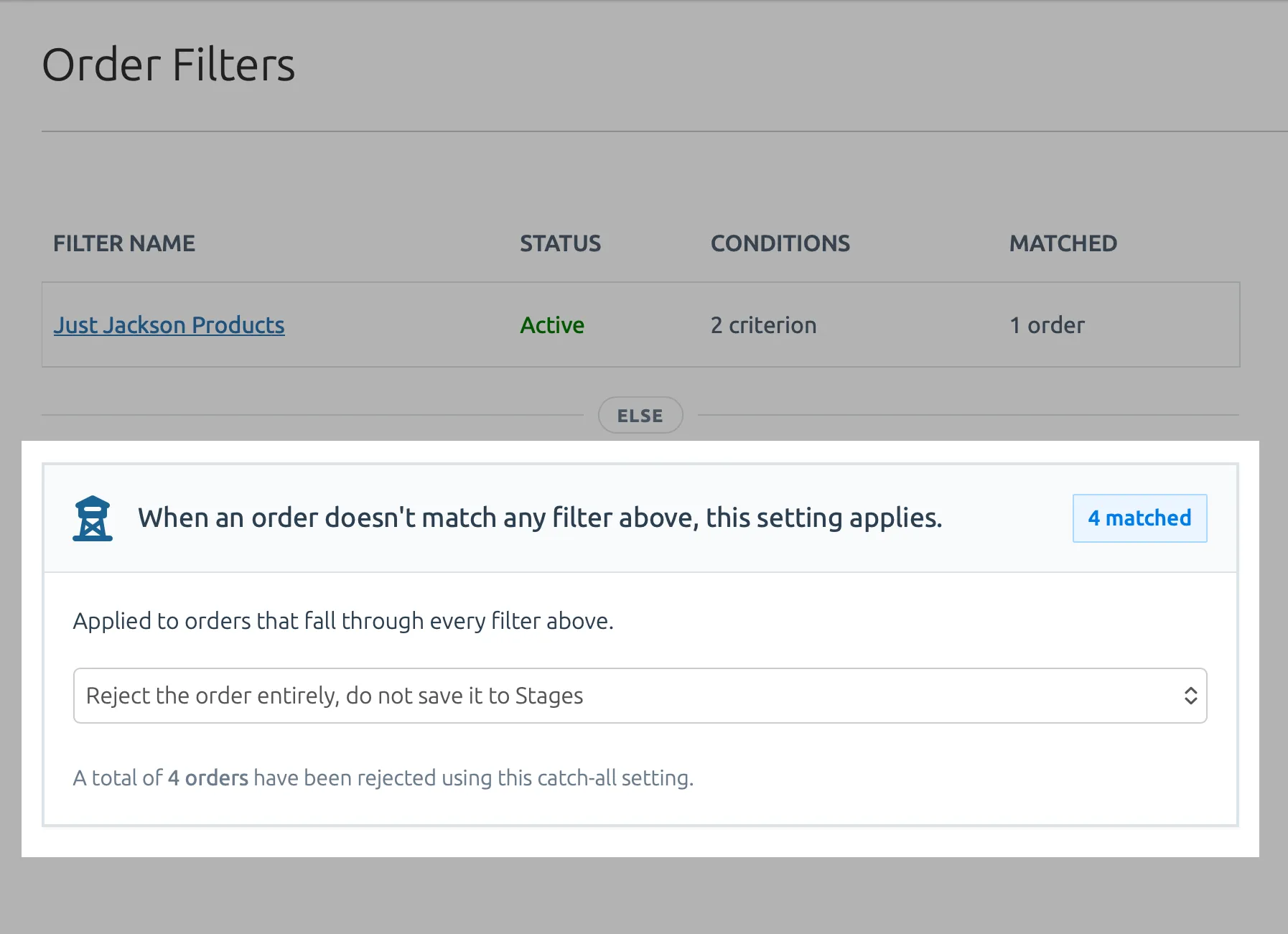
This is a “catch-all” setting for any order that isn’t allowed in by a filter, and it can have three different modes:
- Allow the order, save it to your dashboard in the Stages app, and run any applicable Automation Rules. This is the default behavior, and how the Stages app has historically treated incoming orders.
- Allow the order but skip Automation Rules, which does what it says on the tin: allow the order into the app, save it to your dashboard, but don’t run any rules or send any automated emails.
- Reject the order, don’t save it to the Stages app, and don’t run any Automation Rules.
Evaluation flow
Section titled “Evaluation flow”Order Filters are evaluated before any Automation Rule is evaluated. The filter result determines whether automation rules run for a given event: